American Staffordshire Terrier Care and Breed Comparisons
The American Staffordshire Terrier, often called an AmStaff, is a muscular, active companion dog recognized by the American Kennel Club. Choosing one requires a realistic plan for training, exercise, handling and health care. A breed name is not a guarantee of behavior in an individual dog. [1]
American Staffordshire Terrier and American Pit Bull Terrier are related labels with overlapping history, but they should not simply be treated as interchangeable search keywords. The American Pit Bull Terrier has its own United Kennel Club standard. [2]
AmStaff APBT and other names
| Name | What the name refers to |
|---|---|
| American Staffordshire Terrier | An AKC-recognized breed commonly shortened to AmStaff |
| American Pit Bull Terrier | A breed with a UKC standard commonly shortened to APBT |
| Staffordshire Bull Terrier | A different breed; not a short form for AmStaff |
| Pit bull type | A broad informal description that may be applied inconsistently |
Appearance alone cannot confirm every dog’s ancestry. Ask what records or history support an identification, especially when a shelter, seller or policy uses a broad type label. Historical overlap does not make every dog under these labels identical. [1][2]
Temperament should be assessed individually
Ask about the actual dog: how it responds to handling, unfamiliar people, other dogs, small animals, frustration and being alone. Descriptions such as affectionate or confident are broad tendencies, not promises.
Do not use a nanny-dog claim as a child-safety plan or assume a dog is dangerous solely from its label. Supervision, suitable management and attention to the individual animal’s behavior remain necessary. Provide children and dogs with predictable boundaries and places to rest without disturbance.
If a dog has a history of conflict with animals, discuss it honestly with the rescue, veterinarian and qualified trainer. A successful interaction in one setting is not proof of compatibility with every animal.
Training and daily activity
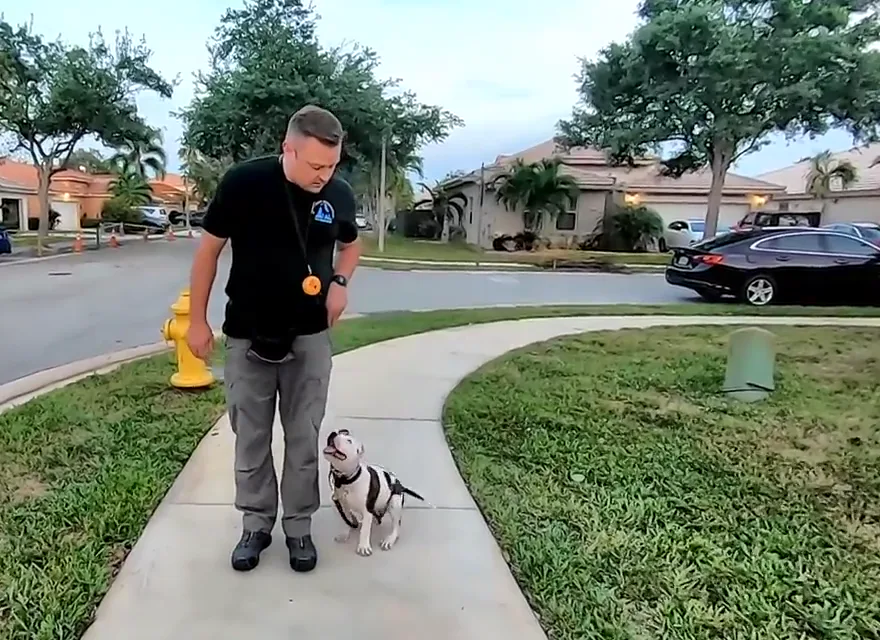
Use rewards and consistent expectations. Teach loose-leash walking, recall in safe enclosed areas, calm handling and settling. Because a strong dog can be difficult to manage physically, practice those skills before relying on them in a busy public setting.
Activity should suit the dog’s age, health and condition. Combine appropriate movement with sniffing, learning and rest. Avoid turning breed strength into a reason for excessive exercise or unsuitable equipment.
For difficulties, describe the trigger and sequence to a qualified trainer. A veterinarian can assess whether pain or illness contributes to a change in behavior. Choose support that considers the dog’s welfare and your ability to manage safely.
Health screening and veterinary care
AKC highlights screening considerations including hip dysplasia, cardiac disease and a genetic test for cerebellar ataxia. Ask breeders for specific reports and an explanation of the results. Screening reduces uncertainty; it does not guarantee that a puppy will never develop illness. [1]
For an adult rescue, obtain available medical records, medication history and any information about skin, movement or other ongoing concerns. Arrange a care plan with your veterinarian rather than adopting an unsourced breed supplement list.
Housing insurance and local rules
Before committing, ask the landlord, insurer or relevant authority which rules apply to the individual property and dog. Obtain current written information. A national breed article cannot settle a local lease, insurance contract or legal restriction.
If paperwork uses a different breed description from the shelter or veterinary record, clarify the discrepancy before bringing the dog home. Do not rely on a seller’s assurance that a label will not matter.
Budget and adoption decisions
Consider ongoing food, veterinary care, training, equipment and care while you are away. An adoption fee or purchase price is only the starting cost. Ask which services and records are included rather than comparing advertised prices alone.
Meet the individual dog when possible and discuss the household’s other animals, children, schedule and handling experience. A rescue or responsible breeder should be able to discuss limitations as well as appealing characteristics.
Get current written housing and insurance information before committing to an individual dog.
Common questions
Is an AmStaff the same as an American Pit Bull Terrier
They have related history and can have overlapping registration contexts, but the names refer to distinct registry standards. Do not collapse all usage into one identical label.
Is a Staffordshire Bull Terrier an AmStaff
No. It is a different breed name and should be researched separately.
Are AmStaffs always safe with other dogs
No breed-wide guarantee can replace assessment and management of the individual dog.
Can a first time owner have an AmStaff
Evaluate the person’s routine, handling ability, willingness to train and access to support. A realistic match matters more than the label first-time owner.
Can a photo confirm my dog’s breed
Not reliably in every case. Appearance, history, records and any testing need to be interpreted with their limits.